Share your light with the world.
Publish articles, videos and podcast episodes on BrightStar, where people already come looking for what you offer.
Sign upIncluded on every plan, Free included.
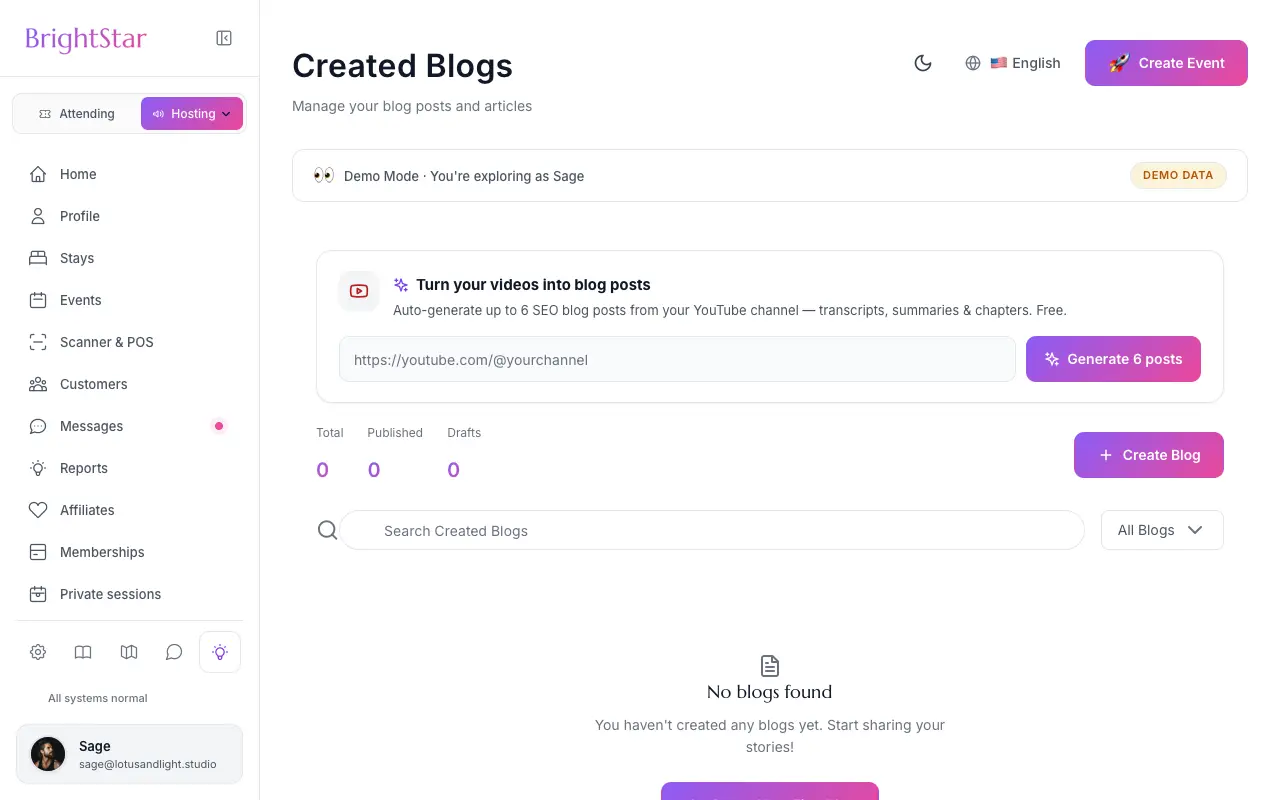
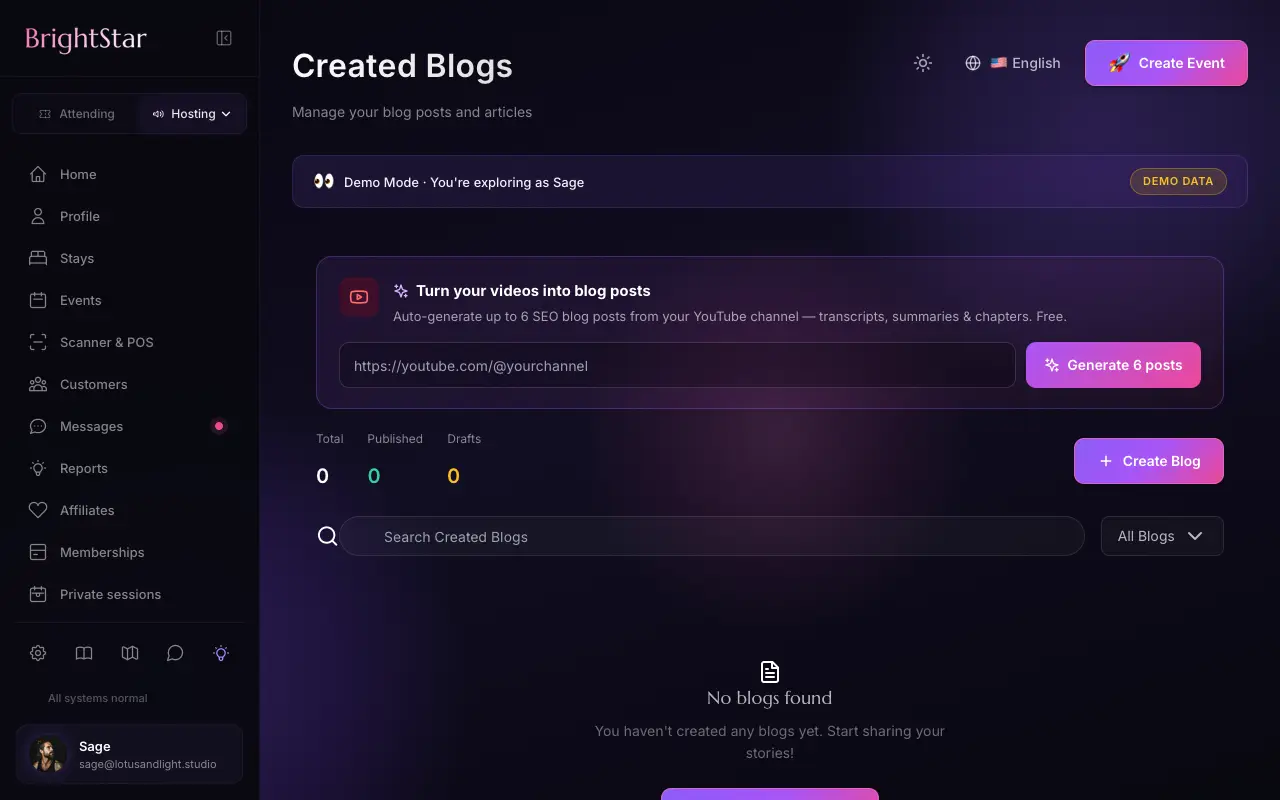
Share your light with the world.
Publish articles, videos and podcast episodes on BrightStar, where people already come looking for what you offer.
Sign upIncluded on every plan, Free included.
A home for content with depth
Articles, videos, podcasts
Long-form teachings, guided practices, album releases and episodes, each with its own page.
Built to be found
Every post carries full structured data with its original publish date, so search engines and AI answers can cite it.
Connected to your events
Posts credit the people in them and link to the events you mention, so a reader is one tap from a ticket.
How it works
Write and publish
Create a post from your dashboard, or embed your video or episode.
It goes live
The post is published with its search markup and shows on your profile.
Readers find you
People arriving from search or AI answers reach your work and your events.
Loved by artists and organizers
“BrightStar has been supporting my concerts since the very beginning of my career and played a pivotal role in growing my audience sizes. Their loyalty and dedication to both artists and event organizers is exemplary, as is their professionalism.”
Snatam KaurGrammy Nominee (Client Since 2005)
“For nearly two decades, Akal (owner of BrightStar) has been lending his skills and talents in support of the Bhakti movement. His platform uniquely serves our movement with authenticity and heart. The technology also rocks!”
Jai UttalGrammy Nominee (Client Since 2014)
“We've been so happy with the outstanding customer service that we've received while working with BrightStar, and feel great about supporting a company that is authentically committed to the ideals of higher consciousness.”

Eric ForbisFounder, BuddhaFest (Client Since 2012)
Questions organizers ask
Is publishing free?
Yes. Publishing on the blog costs nothing.
Can I publish videos and podcasts?
Yes. Video and podcast posts get their own pages and the matching structured data.
Can I write about other people’s events?
Yes. Write about any event on BrightStar you want to recommend; the post links to it.
Read more
Why a ticketing platform has a blog
People do not only search for events. They search for a mantra’s meaning, a teacher’s talk, a guided practice, a review of an album. The answers to those searches are articles, videos and podcast episodes. BrightStar’s blog is where that content lives, next to the events it relates to. For a teacher or musician, publishing here puts your work in front of people who are already looking for it, one tap away from your next date.
What you can publish
Three kinds of post are supported. Articles: teachings, essays, interviews, stories from the road. Videos: talks, practices, performances, each embedded with its own page. Podcast episodes: each with its own page as well, and channel pages that gather a series. A post has a title, an image, your text and the people it features.
Each post is its own page
Every post has a permanent address, a share image and a description for search results. It can be linked from your newsletter and your social profiles like any page on your own site. Posts are grouped into categories, so a reader who finishes one piece on kirtan finds the next.
Built to be read by search engines and AI
Posts are published with structured data that matches what they are: an article is marked as an article, a video as a video, a podcast episode as an episode. Questions and answers inside a post are marked as such. Videos are listed in a video sitemap. This is what allows a search engine to show a video result, and an AI assistant to cite the piece when someone asks the question it answers.
Honest dates
A video or episode keeps its original publication date, the day it was first released on its platform, not the day it was added here. We hold to this because misdating content is a way of pretending it is new, and both readers and search engines are right to distrust that.
Credited to the people in it
A post names the teachers and musicians it features, the way an event lists its line-up, and links to their profiles. So an interview with you leads to your profile, and your profile leads to your upcoming events. Content and calendar are joined.
Linked to events
Where a post mentions an event on BrightStar, it links to it. A reader who has just watched your talk about a retreat can go straight to the retreat page. This is the practical difference between publishing here and publishing on a general blogging site: the next step is present on the page.
Writing about others
You can write about gatherings that are not your own: a festival you loved, a teacher you recommend. The post links to the event, and the people named in it are credited. Generosity of this kind is how a field grows, and it tends to be returned.
The regional emails
BrightStar automatically puts together regional emails from upcoming events near each reader with tickets on sale. Readers who follow artists, venues or organizers also see those people’s new events. These emails go to BrightStar readers. To email your own list, export your customers and use your preferred newsletter service.
What makes a post worth publishing
Depth, not volume. One careful piece that answers a real question will be found for years; ten thin ones will not. Write what you know from practice. Give the reader something they can use today. Use your own photographs where you can. If you publish a video, add a few paragraphs about what it contains, since text is what search engines read best.
Transcripts
For videos and podcast episodes, a transcript is the single most useful addition. It makes the whole content readable by search engines and AI assistants, not only the title, and it serves people who prefer reading or cannot listen.
Who it is for
Teachers with a body of talks. Musicians with releases and stories. Writers in this field. Centers that want to document what happens within their walls. Publishing is free.
What it is not
The blog is not a private membership area and not a course platform. Everything published is public and meant to be found.
Ideas for a first post
If you are unsure where to begin, start with the question you are asked most often. A kirtan leader might explain what happens at a kirtan for someone who has never been. A yoga teacher might write about the practice she teaches and whom it suits. A retreat host might describe a day on retreat, hour by hour. A musician might tell the story behind one song. Posts like these answer what real people type into a search box, and they remain useful for years.
Using a post to support an event
A good time to publish is a few weeks before a gathering. Write about the subject of the event, not about the event itself: the teaching you will give, the music you will play, the place where it happens. Link to the event once, near the end. Then share the post, not the ticket link, on your channels. People respond more warmly to something given than to something sold, and the ticket is one tap away for those who want it.
Images and video
Use your own images wherever possible, and name the people in them. For a video post, the video is embedded from where it is hosted and loads only when the reader presses play, which keeps the page quick on a phone.