Not everyone can pay the same price. And that’s okay.
Let attendees choose what they can pay within the range you set, or give freely, so no one is turned away because of money.
Sign upIncluded on every plan, Free included.
Not everyone can pay the same price. And that’s okay.
Let attendees choose what they can pay within the range you set, or give freely, so no one is turned away because of money.
Sign upIncluded on every plan, Free included.
Pricing in the spirit of dana
Sliding scale
Set a minimum and a maximum with a suggested price; each buyer chooses within it.
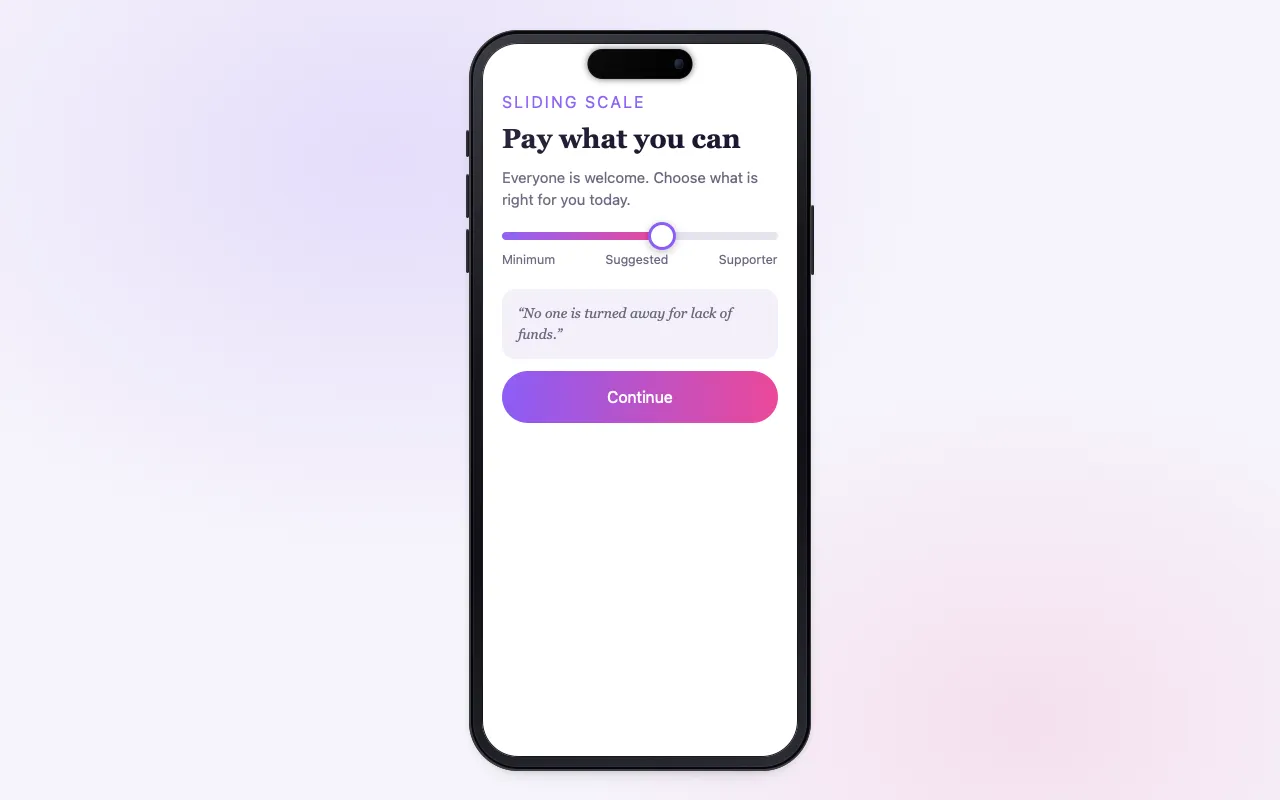
Pay what you can
A suggested amount with no minimum, or donation-only tickets for pure generosity.
A donation at checkout
Add an optional gift for your cause, with preset amounts; it rides on the order and shows in your reports.
How it works
Choose a pricing model
Pick sliding scale, pay-what-you-can or donation-only for a ticket type.
Set the range
Add the minimum, maximum and suggested amounts that keep your offering sustainable.
Welcome everyone
Buyers choose their amount with warm, guilt-free wording at checkout.
Loved by artists and organizers
“BrightStar is a close friend and ally with The Shift Network and has been invaluable in helping us bring attention to our programs. We share common spiritual values focused on uplifting humanity. BrightStar combines professional marketing expertise with heart-centered service.”

Philip HellmichDirector of Peace, The Shift Network (Client Since 2012)
“For nearly two decades, Akal (owner of BrightStar) has been lending his skills and talents in support of the Bhakti movement. His platform uniquely serves our movement with authenticity and heart. The technology also rocks!”

Jai UttalGrammy Nominee (Client Since 2014)
“Not only does BrightStar offer a powerful software platform that has worked very well for my events, but their client support is the best. Their communication is personal, heart-centered, and always thoughtful.”

Peter KaterTwo-Time Grammy Winner (Client Since 2014)
Questions organizers ask
What’s the difference between sliding scale and donations?
Sliding scale lets attendees choose their ticket price within your range. A donation is an optional gift added at checkout. Use either or both.
Can I set a minimum price?
Yes. Set a floor that covers your costs and let people pay more if they are able. The suggested price is shown, but the choice is theirs.
What is dana-based pricing?
Dana means generosity. Dana-based events trust attendees to give what they can and what the experience is worth to them.
Can I see who gave and how much?
Yes. Amounts paid and donations appear on each order and in your revenue reports.
Read more
Pricing that leaves the door open
In many traditions the teaching is offered freely and supported by generosity. In practice, a room still has to be rented and a teacher still has to eat. Organizers of conscious gatherings have long resolved this with sliding scales, pay-what-you-can places and donation evenings, usually managed with a notebook and a basket. BrightStar builds these into ticketing, so that a person with little can come without having to ask, and a person with more can carry a larger share without being asked.
Sliding scale tickets
A ticket type can be set to a sliding scale. You give a minimum, a maximum and a suggested price. At checkout the buyer chooses an amount anywhere in that range, with your suggested price shown as a guide. The minimum is a real floor: an amount below it is not accepted. This lets you set a floor that covers your costs while leaving the choice above it to each person.
Pay what you can, and donation-only tickets
Two further models go beyond a range. With pay what you can, you show a suggested amount and the buyer decides what to give. With a donation-only ticket, entry is by gift alone. Both are ticket types like any other: they have a quantity, they appear on your guest list, and they produce a ticket with a QR code for the door. You can offer them beside fixed-price tickets on the same event, for instance a standard price, a supporter price and a small number of pay-what-you-can places.
A donation at checkout
Separately from the ticket price, you can add a donation step to checkout. You write a line about the cause in your own words, name who the gift supports, and choose a few preset amounts. The buyer taps one or skips the step; nothing is added unless they choose it. This suits a benefit concert, a scholarship fund for a training, or a temple building project that the evening supports.
How gifts appear on the order
A donation made at checkout is part of the same payment as the tickets. It is listed on the buyer’s confirmation email and recorded on the order. In your dashboard, the amount each person paid for a flexible ticket and any donation they added are shown on the order and counted in your revenue reports, so you can see what generosity brought in for a given event.
Words matter here
How an amount is asked for changes how it feels to give. The checkout wording for flexible prices is warm and free of pressure, and the suggested amount is shown as a suggestion. In your own description, say what the range means: who the lower amounts are for, what the higher amounts make possible. People give more readily when they understand what their gift does.
What to know before you rely on it
BrightStar records the gift on the order; it does not issue tax receipts and cannot tell you whether a gift is deductible where you live. If you are a registered charity, or collecting for one, follow the rules that apply to you and send any receipt yourself. A fully free order carries no fees at all.
Where it is included
Sliding scale, pay-what-you-can and donation-only tickets, and the donation step at checkout, are available on every plan, including Free. A dana-based evening can be listed, ticketed and checked in at the door without a platform fee.
How organizers combine the options
A common pattern for a workshop is three ticket types: a standard price, a supporter price for those who can give more, and a limited number of reduced places, sometimes as pay what you can. A kirtan evening may use one sliding scale ticket with a low floor. A benefit concert often has fixed prices plus the donation step for the cause. A sitting group may offer donation-only entry. Because each is just a ticket type, you can mix them freely and limit the quantity of any one.
Setting amounts that sustain you
Generosity-based pricing works when the numbers are honest. Start from what the gathering costs you, divide by a realistic number of guests, and let that guide your suggested price. Set the minimum at a level you can live with if many people choose it. If you offer reduced places, decide how many you can carry and set that as the quantity, so the offer is real but bounded.
Trust, and what experience shows
Organizers new to sliding scales often worry that everyone will pay the minimum. What they pay will depend on your community and on how clearly you explain the range, and we do not claim a typical result. What the tools give you is a clear record afterwards: your orders show what each person chose, so after one or two events you know how your own community responds and can adjust the range.
Free places and scholarships
For full scholarships, you can add a free ticket type with a small quantity for the people you want to invite. This keeps the guest on the same list as everyone else, with a normal ticket, so nobody at the door can tell who paid what. That discretion is part of the welcome.
Rooms and stays
Guests choose their room as they buy their ticket, and every bed is counted so nothing is sold twice.
See the feature →Recurring Events
Create a weekly class or series in one setup, and BrightStar keeps the dates coming and on sale.
See the feature →Online Teaching
Run online classes and series beside your in-person events, with one audience and one dashboard.
See the feature →Private Sessions
Clients book free sessions from your profile today; paid sessions are opening soon.
See the feature →Online Summits
Bring speakers, sessions and passes together in one online event, and let every speaker help spread the word.
See the feature →Ticket Categories
Group your ticket types into clear categories, so buyers see the shape of your event and find their ticket fast.
See the feature →See allThere is more to see.